December 2025
Introduction
South Carolina has higher expectations for public high school students than achieving the 24 credits to graduate.
As shown in high school SC School Report Cards, the “College & Career Readiness” of its graduation cohort (includes both graduates and non-graduates) is one of the biggest factors in determining a high school’s performance rating.
An example of this priority at the school district level is Greenville County Schools’ “Graduation Plus.”
The state has specified eleven ways that South Carolina high school students can become college or career ready (see Appendix).
Examples for “college ready” are completing six or more credit hours of dual enrollment, college-level courses with grades of C or better or achieving a high score on an advanced placement (AP) exam.
Examples for “career ready” are passing an employer exit exam from a work-based learning experience or completing a set of career and technical education (CTE) coursework with one or more industry certifications.
The new and higher “career ready” requirements for CTE students are the focus of this article.
New CTE “Career Ready” Requirements
Overview. Starting with the current school year, high school freshmen and sophomores in the state have new requirements for becoming a “Career-Ready CTE Completer.” In some school districts current juniors and seniors will continue to operate under the previous requirements. In others they will come under the new provisions.
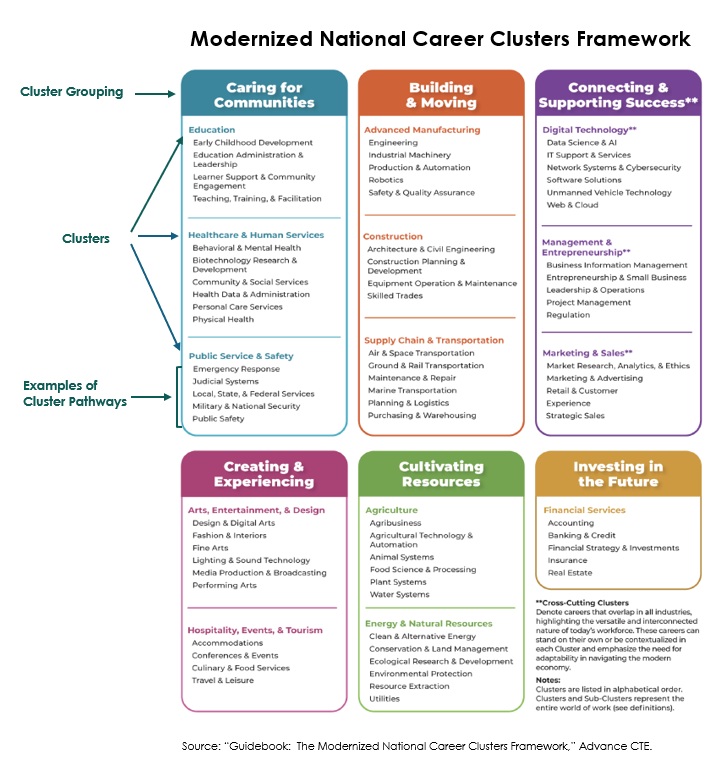
The CTE system in the state follows the new “Modernized National Career Clusters Framework,” in which the entire sphere of career possibilities are broken down into 14 “Career Clusters.” Examples of a cluster include “Healthcare and Human Services,” “Advanced Manufacturing,” and “Marketing and Sales.” For each of the clusters there are multiple “Cluster Pathways.” (See “Framework” diagram below.)
To become “career ready,” a CTE student completes coursework in a selected Pathway and within those courses attains one or more industry certifications (credentials) totaling a specific set of 3 or more points.
Each certification has a point value of 1 to 3 indicating its difficulty and value to an employer. To satisfy the three-point requirement, a student must achieve at least one 2-point or 3-point certification.
Upon meeting the coursework and certification requirements, a student is a “Career Ready CTE Completer.” Students may accomplish this in more than one Cluster Pathway.
These are higher requirements. Under the previous system, CTE students were “career ready” with the completion of any one industry certification.
Completing the Required Set of Pathway Courses. In a chosen Pathway a student must pass three or four courses to become a “CTE Completer.” In some Pathways, such as Sports Medicine and Introduction to Teaching, the first two are required courses. The third course (and fourth if required) is chosen from a list of other courses in that Pathway. In other Pathways, such as Welding and Digital Art & Design, there are only required courses.
Earning Industry Certifications Within that Coursework. Included in Pathway courses are opportunities for students to earn industry certifications at different point (Tier) levels. Here is an example of coursework in a Pathway and the available industry certifications that can be attained in those courses.
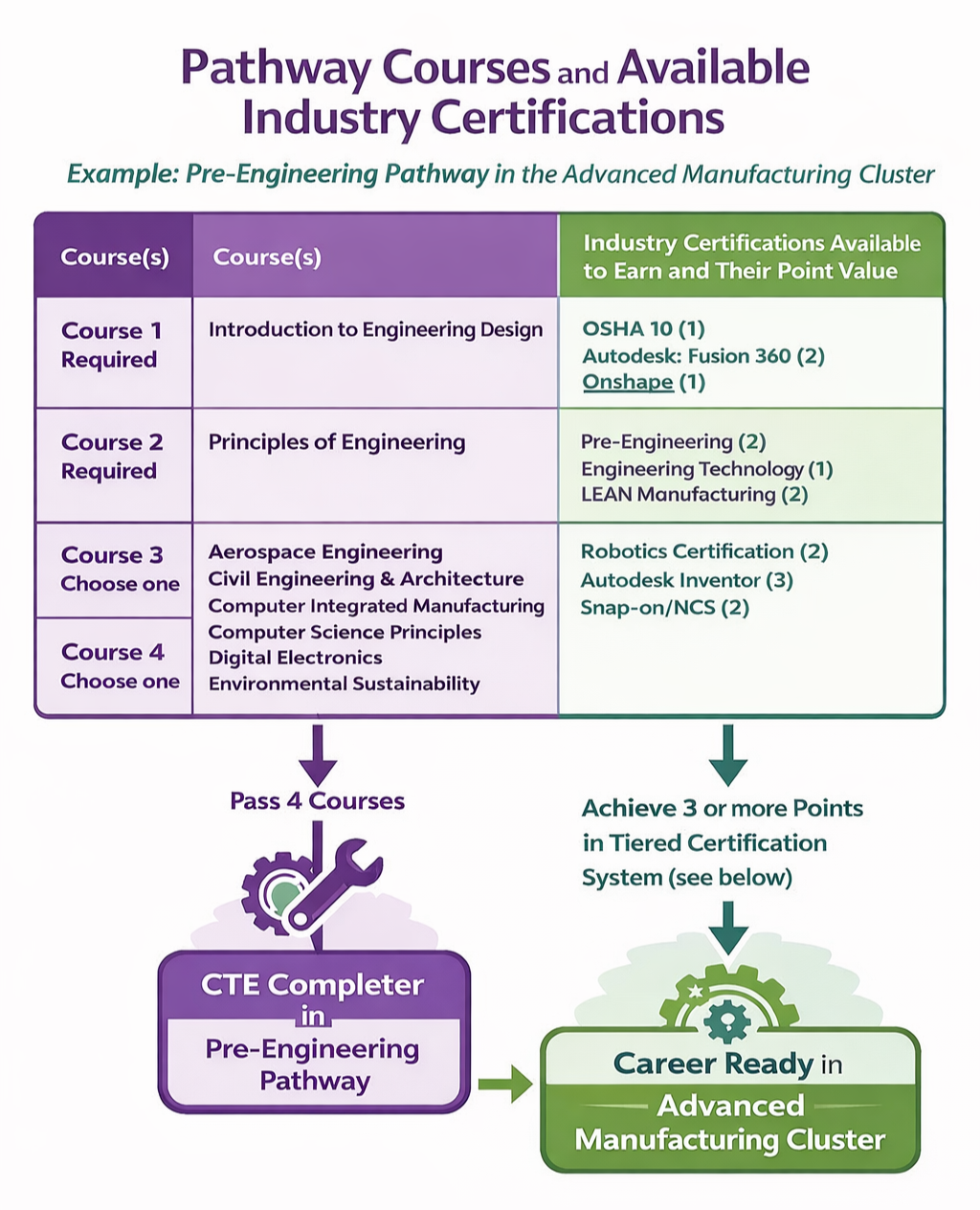

The Tiered System of Certifications. As shown in the chart above, each state-approved industry certification (credential) now has a Tier 1, Tier 2, or Tier 3 designation (worth 1, 2 or 3 points). See the descriptions below of the certification Tier levels: Introductory (Tier 1), Intermediate (Tier 2), and Career Ready (Tier 3).
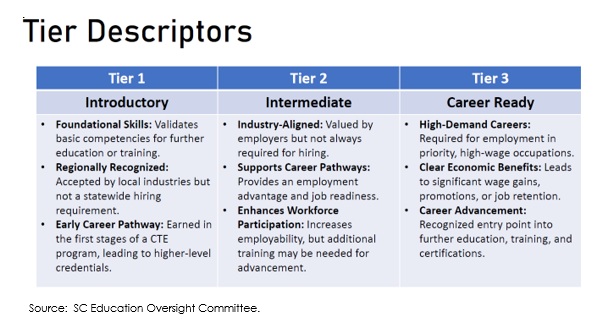
Using the Certifications to become “Career Ready.” In the new Tiered Certification (Credential) System, a student achieves “career ready” status by earning at least three points through one of the following industry certification combinations:
- One Tier 3 certification (credential) aligned with their Career Cluster
- A combination of one Tier 2 and one Tier 1 certification within the same Cluster Pathway
- A Universal Credential (e.g., OSHA 10) paired with a Tier 2 or Tier 3 certification in a student’s Career Cluster.1
Through successful completion of Pathway coursework and 3 points or more in tiered certifications related to that Pathway and Cluster, a student achieves “Career Ready CTE Completer” status.
Additional Information. All certifications in South Carolina are approved based on recommendations from state technical advisory councils that include business/industry experts, educators, and workforce agency representatives. New certifications are approved on an annual basis. 2
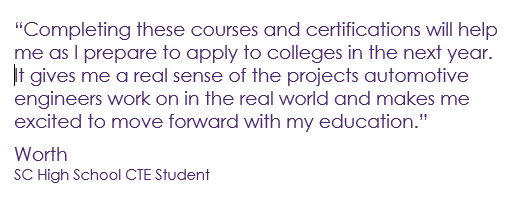
Each career center and high school offers a certain set of pathways. Some pathways may be available at more than one center or school in a school district. Others may only be available at one location in a district or not at all. Each school year, centers and schools may add or change the pathways and associated industry certifications they offer based on student interest, new technologies, and the needs of local employers.
Public Education Partners Greenville County (PEP) is deeply grateful for the time, expertise, and assistance provided by Mr. Eric Williams, Assistant Superintendent for Secondary Schools and Career Centers, and Dr. Jamie Whitlock, Academic Specialist for Career & Technical Education, at Greenville County Schools in the preparation of this article. PEP is solely responsible for its content.
Note: “The “Industry Credential and Work-Based Learning” data dashboard in InformEdsc presents certification data under the previous system until students under the new tiered system graduate.
NOTES
1“SC Tiered Credential System,” ASA Subcommittee Meeting, May 19, 2025, SC Education Oversight Committee.
2Ibid.
APPENDIX
College Ready and Career Ready Criteria
2025-26 Accountability Manual, SC Education Oversight Committee
A student is deemed “college-ready” if the student met one or more of the following six criteria:
- Scores a composite score of 20 or higher on the ACT
For students with multiple ACT scores, the highest composite score from any single administration may be used.
- Scores a total score of 1040 or higher on the SAT
For students with multiple SAT scores, the highest total score from any single administration may be used.
- Scores a 3 or higher on an Advanced Placement (AP) exam
- Scores a C or higher on any approved Cambridge International Exam
- Scores a 4 or higher on any International Baccalaureate (IB) higher learning (HL) exam
- Completes at least six (6) credit hours in approved dual enrollment courses with a grade of C or higher
A student is deemed “career-ready” if the student met one or more of the following five criteria:
- A CTE Completer with three points of aligned certifications
- Earns a Level 3 Credential or above on the WIN SC Career Ready Test
- Earns a scale score of 31 or higher on the ASVAB (for careers in the military)
- Successfully completes a state-approved work-based learning exit evaluation from an employer. Completion of either a minimum of 40 practical experience hours or the highest number of hours required by industry-defined competencies in a career pathway is required.
- Is identified as a student with a disability who successfully completes the South Carolina High School Employability Credential according to their Individualized Education Plan (IEP)