
Introduction
“State Aid to Classrooms” is the primary way the state funds public schools in South Carolina. Although school districts can use these funds for any purpose, the main use of these funds is teacher salaries.
Annual funding for State Aid to Classrooms in the state budget is currently based on a ratio of one teacher for every 11.2 students in the state and the cost (salary and fringe benefits) of a teacher with 12 years of experience and a master’s degree.
The State Aid that a school district receives from the state is based on a formula that involves several elements. The primary factors are the district’s percentage of total weighted pupil units in the state (see Appendix) and its ability to raise revenue from local property taxes relative to other districts (Index of Taxpaying Ability).
This is no separate state law on State Aid to Classrooms. Instead, the law on State Aid is written into the annual state budget: a budget “proviso.” As with the budget, it is a one-year law. Changes to the law (Proviso 1.3) are just written into the next year’s budget.
Here are four main changes to the State Aid to Classrooms funding formula for the 2026-27 school year.
Contents
- State Funding for CTE Equipment at Career Centers
- State Aid Funding for Charter Districts
- State Funding for District Health Insurance
- State Aid “Hold Harmless” Funding
Sources
Appendix
1. State Funding for CTE Equipment
- State funding for career-and-technical-education (CTE) equipment at career centers has been included in State Aid to Classrooms. This will not be the case for the 2026-27 school year.
- Under the previous State Aid funding formula CTE students had a higher base weighting (1.2) than “regular” students (1.0). The additional 0.2 weighting accounted for the additional equipment CTE students need.
- Under the new formula this additional student weighting is removed and CTE students are included in the “regular” students weighting of 1.0. (See Appendix.)
- The amount of CTE equipment funding in FY26 State Aid from the 0.2 weighting is added to a pre-existing CTE equipment line item for the upcoming year.
- This is a one-time addition to the CTE equipment line item. These funds will be allocated proportionally to school districts and not under the State Aid formula (see Appendix). This amount will no longer annually increase based on the State Aid formula. Any increase will now require a separate legislative appropriation.
- In making this change, no funding is removed from State Aid to Classrooms. What was the “CTE Equipment” amount remains in State Aid and is now free to use for teacher salaries.
- The amount added to the CTE line item is a one-time increase in funding for school districts.
- Under this new arrangement, the minimum a district and multi-district career center will receive from CTE
line-item funds is $250,000.
IMPACT
♦ One-time state funding increase for school district General Fund budgets;
♦ Increase in the annual amount of State Aid that can go for teacher pay;
♦ The amount to career centers for CTE equipment no longer automatically increases: any increase must
come through a separate legislative appropriation.
2. State Aid Funding for Charter Districts
New: There is no longer a different base weighting for charter brick-and-mortar school students (1.25) and for charter virtual school students (0.50). The base weighting for these students is now the same as for “regular” students in “regular” schools at 1.0. (See Appendix.)
There are now two parts of State Aid funding to charter districts. The first is determined through the previous weighting formula.
The Same: In the weighted State Aid formula regular school districts are responsible for, on average, 25% of their total State Aid amount with the state providing 75%.
Because charter districts do not have local property tax revenue, the State totally funds their 25% “local” portion of State Aid: charter districts receive 100% funding from the state.
New: There is now a second part of State Aid funding for charter districts that provides additional funding through add-on weightings: 1.25 for charter brick-and-mortar (B&M) school students and 0.50 for charter virtual school students. (See Appendix.)
REASON
Short Answer: The weightings for charter schools are based on the type of charter school (brick-and-mortar or virtual) and not student characteristics and should be separate from the student weightings. The additional charter weightings provide funding for educational needs beyond funding for instructional positions.
Details: Prior to State Aid to Classrooms, the “Education Improvement Act” (EIA) part of the state budget provided funding to charter districts for other educational needs beyond funding for instructional positions. (See more on the EIA in the “Learn More” post “State Funding for Public Schools in South Carolina – An Overview.“)
When the funding method changed to State Aid to Classrooms, the funding for charter additional educational needs was accounted for with charter-specific student base weightings.
The separate distribution of the additional funding would be allocated to the charter districts based on only the B&M and virtual weights (excluding all other student weights) as these are the weights that generate this funding.
The B&M and virtual weights would only be used to allocate additional resources among the charter districts and would no longer be included in the SAC [State Aid to Classrooms] formula WPU. (page 40 in the Revenue and Fiscal Affairs Report listed in Sources)
IMPACT
♦ No school district will lose funding due to the additional funding for charter districts through the add-on
weightings. Under the “hold harmless” provision in the State Aid revision, every regular school district will
receive at least the same formula State Aid funding it received in FY26. (Under State Aid, districts also receive
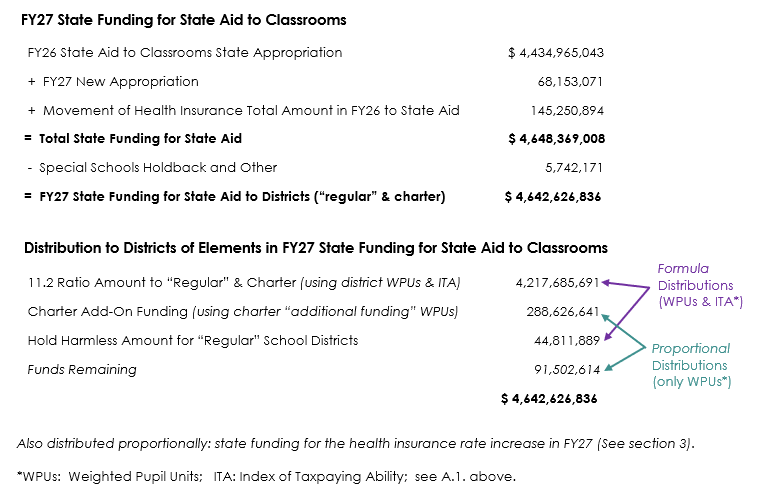
proportional State Aid funds, which may increase their overall State Aid funding for FY27. See Appendix
for example showing formula and proportional distributions.)
Note: The state-funded portion of State Aid to Classrooms has been increasing due to higher enrollment
growth in charter districts than in regular school districts. With 100% state funding for charter districts,
state-funded State Aid is not 75% of the total but is now about 78%.
3. State Funding for District Health Insurance
State funding for school district “Health Insurance – Employer Contributions” has not been included State Aid to Classrooms funds but has come under the “Employee Benefits” section of the state budget. As such, the state total is distributed to school districts proportionally based on the district’s percentage of statewide weighted pupil units (WPUs). (See Appendix for more on WPUs.)
New. The total amount of state funding for district health insurance in the current year’s (FY26) state budget under “Employee Benefits” is moved to the upcoming year’s (FY27) State Aid to Classrooms.
Same. State funding to school districts for the upcoming year’s (FY27) rate increase amount for health insurance remains in the “Employee Benefits” section.
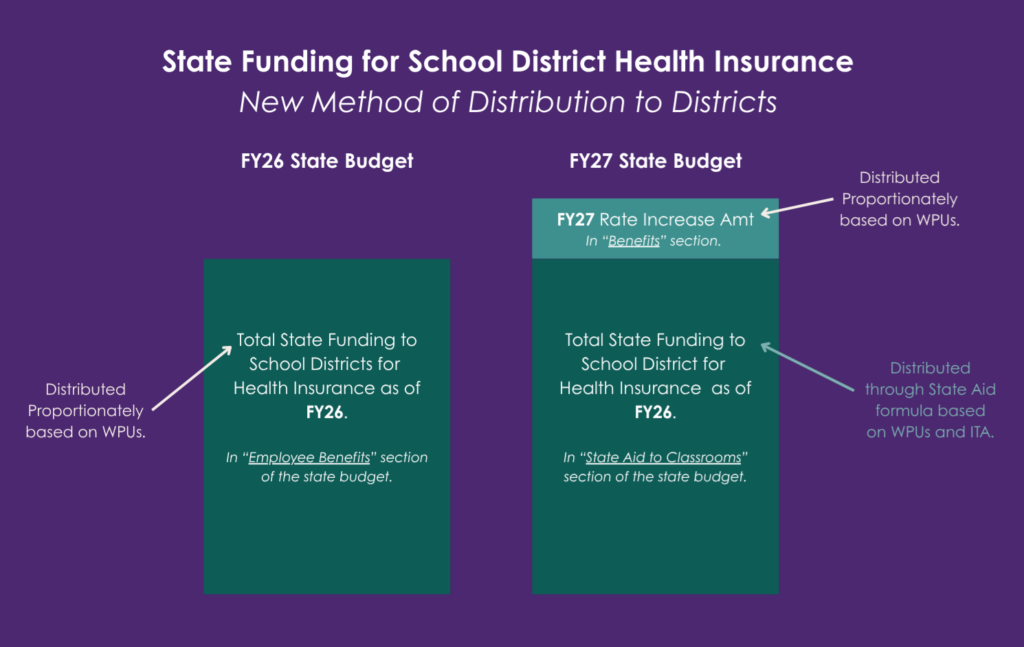
New Distribution to Districts. The upcoming year’s (FY27) rate increase amount in the “Employee Benefits” section of the state budget will continue to be allocated proportionately based on a district’s percentage of weighted pupil units (WPUs) among all school districts.
However, the current year’s (FY26) state amount that has been moved to State Aid to Classrooms for FY27 will now be distributed to districts in a different way than it was previously (based solely on WPUs). As part of State Aid, it will now be allocated to school districts based on the State Aid formula which includes both the district’s percentage of WPUs and its ability to raise local revenue through their school operations property tax relative to other districts (Index of Taxpaying Ability – ITA).
New Annual Transfer. Each year going forward, the current year’s rate increase state total in “Employee Benefits” will move into the upcoming year’s State Aid to Classrooms total. With this transfer, the distribution of these funds to school districts will change from proportional (WPUs) to the State Aid formula (WPUs and ITA).
IMPACT
♦ State funding for school district health insurance employer contributions will now be primarily distributed
based on the State Aid funding formula, which takes into account the property tax wealth of a district (its
Index of Taxpaying Ability – ITA) in addition to its weighted pupil units.(WPUs). Up to this point these funds
were distributed proportionally based on WPUs.
4. “Hold Harmless” for State Aid to Districts
As discussed above, no school district will receive less in State Aid formula funding than they did last year. If the State Aid amount a school district receives under the new formula is less than last year’s (FY26) formula amount, they will additionally receive a “hold harmless” amount so that the formula amount they receive will not decrease. (Note: Under State Aid to Classrooms, districts also receive proportional State Aid funds. See Appendix for an example.)
For a “hold harmless” apples-to-apples comparison, adjustments are made to the formula amounts for the two years. CTE funds are removed from the FY26 amount (not included in FY27) and health insurance funds are removed from the FY27 amount (not included in FY26).
It is unknown how this will be accounted for in future years. The state law on State Aid to Classrooms is not a separate, approved law. It is, and has been, a “proviso” in the state budget: a one-year law written into the budget that can be revised every year through the state budget process. No one knows how the legislature will handle this in the next budget bill. At some point, State Aid to Classrooms could be written into the state’s Code of Laws.
IMPACT
♦ In preliminary calculations by the SC Dept. of Education (using FY26 45th-day student headcount), 43 of the 72
“regular” school districts (60%) will receive less funding under the new State Aid formula and will receive hold
harmless funding from the state.
While the formula amount of State Aid for these districts will not change, their total amount of State Aid will
increase. This is because the amount the legislature appropriated for State Aid in FY27 is more than required
by the formula. Under State Aid, any leftover amount is distributed proportionately (by WPUs) to districts.
Sources
Proviso 1.3, Part IB of the FY27 Appropriations Bill, H. 5126, House and Senate version.
“State Aid to Classrooms: Review of Student Weights and Alignment of Funding with Student Enrollment,” SC Revenue and Fiscal Affairs Office, October 15, 2025.
Wren, Lisa; Rainwater, Frank et al., SC Revenue and Fiscal Affairs Office, phone conversation, March 25, 2026.
SC Dept. of Education State Aid to Classrooms worksheet figures for the House Ways & Means Committee, January 2026.
“Budget Planning for Upcoming Fiscal Year,” “Fiscal Year 2026-2027,” SC Dept. of Education.
Meetz, Stephanie L., Research/Budget Analyst, SC House Ways & Means Committee, phone conversations, April 27 and May 5, 2026.
Byers, Joshua, Accountant/Fiscal Manager, SC Dept. of Education, emails, May 7, 2026.
Appendix
A. Change in State Aid Weighted Pupil Units (WPUs) from FY26 to FY27
1. Change in Weightings for “Regular” School Districts and Charter Districts.
Shown are the changes in the Weighted Pupil Units (WPUs) used in distributing total State Aid to all school districts. Each student is assigned a “base weighting.” A student’s total weighting (WPU) is the “base weighting” plus each of the “additional weightings” that apply to that student.
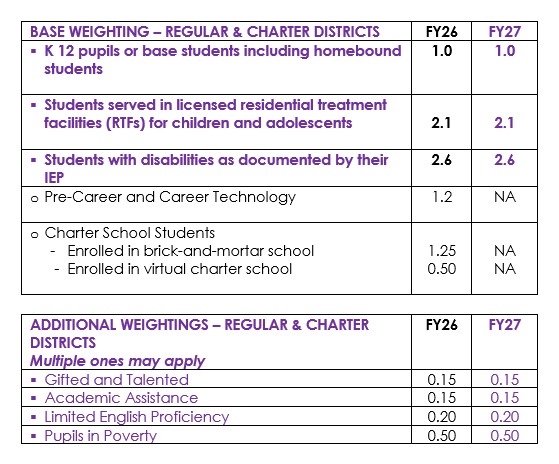
A district’s total WPUs and its ability to raise revenue from its property tax base (Index of Taxpaying Ability) determines the State Aid formula funding a district receives from the state. On average, a district is responsible for 25% of its State Aid total with the state providing 75%. Since charter districts do not have a property tax base, they receive 100% funding from the state.
Note: With the state picking up the local share for charter districts, the total state portion is above 75%. In FY25 it was 78% and that figure will increase as student growth in charters outpaces that in regular districts.
2. NEW – Weightings for Additional Funding to Charter Districts beyond the 100% Funding they receive above.

Under the revised State Aid to Classrooms proviso, beginning in FY27, charter districts receive additional funding from the state, beyond what it receives in “1.” The additional funding for a charter district is based on its total “Additional Funding Weightings” using the weights above for a pupil in a brick-and-mortar charter school and one in a virtual charter.
Calculation of a charter district’s additional funding: the district’s total of these “Additional Funding” WPUs divided by the total state WPUs already calculated (regular + charter) in “1.” provides the district’s percentage of additional charter WPUs. This percentage is multiplied by the charter “100%” funding amount to get the additional funding for charter districts.
Source: “State Aid to Classrooms: Review of Student Weights and Alignment of Funding with Student Enrollment,” SC Revenue and Fiscal Affairs Office, October 15, 2025.
B. State Aid to Classrooms: Formula and Proportional Distributions to Districts (Example)
Source: SC Dept. of Education State Aid to Classrooms worksheet figures for the House Ways & Means Committee, January 2026.